|
|||||||||||||||||||||||||||
|
|
||||
![]() |
History
|
||||||||||||||
|
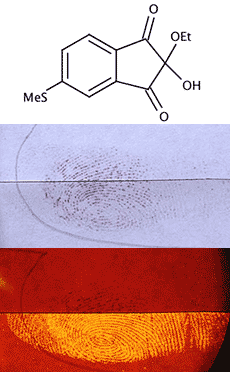
The formula published by Wiesner [5] was validated and published by the FBI and the Florida Department of Law Enforcement [7] to fulfill "the Daubert requirement that scientific processes be validated and subjected to peer review." A number of substituted indanediones (e.g., 5-methoxy and 5,6-dimethoxy; for the chemical structures see this pop-up window) gave superior fluorescence compared to DFO (especially the 5,6-dimethoxy-1,2-indanedione). Unfortunately, synthesis of these substituted indanediones is somewhat complex and makes their production rather costly. In addition, 5,6-dimethoxy-1,2-indanedione was found to suffer from low solubility in the preferred apolar solvents (e.g., petroleum ether) used in most fingerprint laboratories. The testing of 1,2-indanedione by groups around the world has shown that it can be used as a replacement for DFO. However, working solutions (in the currently recommended apolar solvents) do not appear to be stable indefinitely. Indanedione molecules will eventually interact to form compounds that will not visualize latent prints. Therefore, working solutions should be made up whenever needed and should not be kept for extended periods of time (i.e., no more than several weeks). However, in the powder form the compound is completely stable. Like ninhydrin, latent prints visualized with indanediones can be treated with zinc chloride to slow the fading of visible and luminescent detail. In general, an increase in fluorescence is also observed after treatment with zinc chloride. Cooling in liquid nitrogen, after zinc treatment, was found to further increase the fluorescence [3]. Developing prints on recycled paperOn a number of low quality papers (like newspapers, cardboard, and recycled paper in general) we found that indanediones did not develop fingerprints, where ninhydrin and DFO did. In general, however, the UK Police Scientific Development Branch (PSDB) concluded after experiments with a range of papers that in practice there is little difference between DFO and 1,2-indanedione. Developing prints on thermal paperResearch by Jon Stimac [8] of the Oregon State Police showed that the HFE-7100 formulation published by Wiesner et al. [5] of IND can be used on thermal papers. Thermal paper (fax paper) is used extensibly for printed receipts in automatic teller machines (ATM) and point-of-sale registers. The active layer in the paper is very susceptible (turns dark or the print dissolves) for polar solvents like acetone, ethanol and acetic acid. This makes use of DFO and ninhydrin on these papers problematic. For this reason development of prints on thermal paper is best done at room temperature (excessive heat will discolor the paper also). FormulationsThe following working solutions were developed by the PSDB: Note that solvents like pentane and heptane can be substituted for petroleum ether. The 1,2-indanedione should first be added to the mixture of ethyl acetate and acetic acid and allowed to dissolve completely. The petroleum ether (or HFE 7100) should then be slowly added to the mixture. HFE 7100 is the current recommended replacement solvent (consisting of a mixture of two hydrofluoroethers) for Freon (1,1,2-trichlorotrifluoroethane, also known as CFC-113, Frigen, Arklone, and Fluorisol). Note also that methanol or ethanol should not be used in the working solutions. These solutions are not stable over more than a few weeks [4, 5]. Store the solution in a dark brown glass bottle, in the dark. From the chemical literature it is known that 1,2-indanediones are prone to photochemical reactions upon exposure to sunlight. Since most groups that have studied 1,2-indanedione found
higher concentrations (up to 5 grams per liter) to give stronger fluorescing prints,
we recommend the following modified solution, based on the petroleum ether formulation
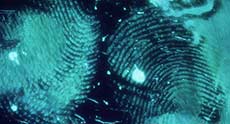
of the PSDB: The formulation used by Wiesner et al. [5] does not contain acetic acid. They found that acetic acid did not improve the results, but had a detrimental effect on the clarity of the prints in their HFE-7100 formulation: The best method for developing prints on documents with these compounds is still being investigated. For 1,2-indanedione, most groups that did research in this area used a humidity oven (10-20 minutes at about 100° C, with approximately 60% relative humidity). At BVDA, we used only dry heat. However, we found that latent prints continued to develop on samples when left overnight (and afterwards) at ambient laboratory conditions. The PSDB reported optimum development when documents were heated for 10 minutes at 100° C (no humidification). Australian researchers [3] preferred a heat press (15 seconds at about 120° C) or 160° C for 10 seconds [9a, 9b] to dry heating for 20 minutes at 100° C. The validation study of the FBI and Florida Department of Law Enforcement [7] concluded that best results were obtained by heating for 2-5 minutes in a photographic mounting-press at 100° C (a similar procedure as used by the Australians [3]) compared to heating in an oven at 100° C for 20 minutes. Prints developed with 1,2-indanedione will fluoresce under green light (optimum about 530 nm), similar to DFO. Optimum viewing and photographing is done with dark orange glasses/filters (cut on point 570-590 nm). Sensitivity to lightResearch has shown that developed prints are sensitive to daylight. Decreasing fluorescence intensity was observed when prints were not stored in the dark. When stored in the dark, prints retain their fluorescent properties for a long time. The green light used to view and photograph the fluorescence appears to cause only a temporary decrease in fluorescence intensity, and only after extended periods of exposure (several hours). The fluorescence returned after storage in the dark overnight, according to the PSDB. Procedure for preparation of the zinc chloride solutionFor the treatment with zinc chloride, we developed the following non-CFC formulation. We have found it to be very reliable and stable (we have stored and used solutions that were several years old, without any problem). In Europe this solution can be obtained from us. Dissolve 30 grams of zinc chloride in a mixture of 500
ml methyl-tert-butylether (MTBE) and 20 ml of anhydrous ethanol (98% or
more) using a 1 liter erlenmeyer flask, a magnetic stirring bar, and a magnetic
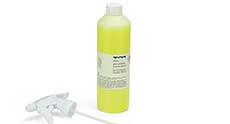
stirrer, in a fume hood. It will take about 30 to 60 minutes to dissolve completely. The zinc chloride solution is particularly stable, also at low temperatures. In principle it can be kept indefinitely. Procedure for treatment with zinc chlorideZinc chloride treatment of prints on paper, developed with 1,2-indanedione, is a very simple procedure. We recommend that a sprayer should be used in a fume hood to apply the zinc chloride. Spray the solution on the article lightly, allow the solvents to evaporate, and then spray the article again if needed. There is, however, no change of color or any other indication that spraying was sufficient as in the case of ninhydrin. References[1a] Ramotowski, R.; Cantu, A.A.; Joullié,
M.M.; Petrovskaia, O., "1,2-Indanediones: A Preliminary Evaluation of a New
Class of Amino Acid Visualizing Compounds", Fingerprint Whorld 1997,
Vol. 23, No. 90, pp. 131-140. |
| HOME | | | ABOUT US | | | CONTACT | | | SEARCH | | | PRODUCTS | | | PRODUCT INFORMATION | | | DOWNLOAD CATALOGUE | | | THIS PAGE IN |
|