|
|||||||||||||||||||||||||||
|
|
||||
![]() |
This manual contains the following sections: Page 1:
|
|||||||||||
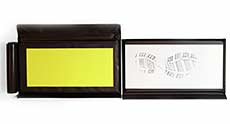
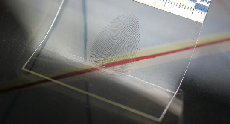
Photographing PrintsPrints can easily be photographed with reproduction lighting in a dark room. The oblique lighting (from e.g. a film spot at a 45° angle) should come from one side. The film of the camera has to be parallel to the Gellifter. All reflections should be avoided, therefore photographing should be done in a totally dark room. To avoid reflections, the camera should be shielded from the light source (e.g. with black cardboard). Next to the Gellifter, a ruler should be present, together with a case number or the like. Before photographing the print, the cover sheet must be removed. To avoid contamination, care should be taken to work in a dust-free environment (e.g. no smoking while photographing). Shoeprints (dust marks) on black Gellifters are the most difficult to photograph. To establish the correct level of lighting, you should take a set of photographs at different shutter speeds (usually diaphragm 11 is taken as a standard) of a test print (dust print) to establish a standard for the mounting you use. Due to the extreme black of the foil, substantial overexposure is possible, thereby enabling the reproduction of even very weak traces. Once the standard is set, the camera can be adjusted to the film sensitivity you have established as being effective (a 125 ASA film can for example be found to have an effective film sensitivity of 32 ASA). Where traces are poor (poorer than the standard), longer shutter times are necessary. In the case of powdered shoeprints, much more light is reflected towards the camera. Therefore, shorter exposure times need to be used. The same holds for lifted (powdered) fingerprints. For reproduction of all the details in dust prints, the weakest ones (or the part farthest away from the spot) should provide the criterion for the exposure time. Relative overexposure of other parts is corrected in printing. To be certain that a good reproduction is made, a cascade of three exposures is normally taken. Due to the oblique lighting, the side of a Gellifter closest to the lamp receives more light than the other side. Therefore, it is advisable to put the side of the Gellifter with the weakest details closest to the light source. Following the abovementioned procedures, the normal grades of photographic paper ordinarily suffice in printing. Overexposure of, e.g. the side of the Gellifter closest to the light source, is corrected when printing the negative. Paint Traces
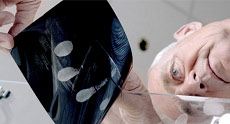
Taking Samples of Micro TracesDue to the non-aggressive nature of the Gellifter, samples of micro traces and hair can be taken without fear of damaging the material. If it is necessary to remove micro traces from the Gellifter, the low tack facilitates their removal with the use of a scalpel or suitable pair of tweezers. Hair samples are taken with white Gellifters. If an area is to be searched for micro traces, we recommend dividing it into squares (e.g. 20x20 cm, approximately 8x8 inches) and using a fresh piece of Gellifter for each square. The size of the Gellifter is actually dictated by the amount of contamination in the area to be investigated, since taking samples of dirt or large amounts of micro traces will result in a rapid loss of tack. A size of 8x8 cm (approximately 3x3 inches) usually suffices. Bullet Holes in Window-panes
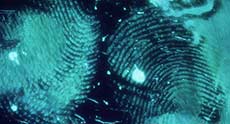
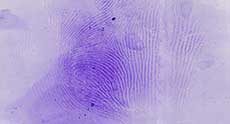
BloodBlood stains can be lifted by using white Gellifters, for example. These are left for one or more minutes on the stain (to humidify) before they are picked up. WARNING: Since gelatin is a protein, it will no longer be possible to analyse a stain once it has been lifted. Gelatin will interfere with the analysis of protein present in blood! Photographing blood stains is the preferred method. On a non-absorbent surface, most prints will improve with chemical enhancement. In many situations, the treated print can still be lifted after chemical enhancement and photography. Lifting the stained print with a white Gellifter eliminates any background interference (example in a pop-up window). The print must be photographed soon after it has been lifted (preferably less than one hour), as the dye from the enhanced print will diffuse across and into the gelatin layer of the Gellifter. This will not be noticeable until a couple of hours after the lift. The diffusion is irreversible and continues even in freezing temperatures. The Gellifter can therefore not be stored. Lifting procedure: apply the white Gellifter carefully in order to avoid trapping air bubbles which could result in an incomplete transfer. Leave the Gellifter on the print for at least a couple of minutes to half an hour. Suitable treatments which can be followed by lifting, include:
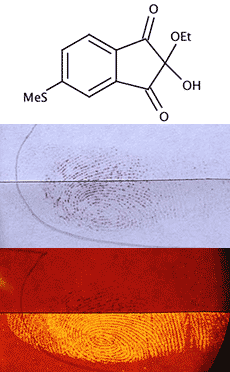
Fluorescence: The use of Hungarian Red has one further advantage. The lifted print strongly fluoresces on a white Gellifter under green light (example in a pop-up window). A red barrier filter is used for viewing and photographing the fluorescence. |
|
Indented writing
Effective temperature rangeThe maximum temperature of an object from which a lifting can be effected, is 40° Centigrade (104° Fahrenheit), since the gelatin layer will melt between 40° C and 45° C (104° and 113° F). Objects which are left to stand in the sun, soon exceed this temperature limit. These objects will first have to be cooled down before lifting is done. The temperature in cars left in the sun can rise very high. Therefore, the Gellifters should certainly not be left in sunlit areas, but kept in shaded areas (e.g. under the front seat). In very hot climates it may be necessary to use a cool box. The Gellifters can be used in freezing temperatures. The rubber of the black and white Gellifters can become somewhat less flexible, though the main problem at these temperatures is removing the cover sheet. This becomes more difficult at lower temperatures. It can be circumvented by keeping the Gellifters in a warmer environment prior to use in a very cold area. We have received reports of problem-free lifting at temperatures as low as -15° Centigrade (5° Fahrenheit). StorageGellifters are normally stored at room temperature (20° Centigrade, 68° Fahrenheit), though storage in a refrigerator is not harmful. Black and white Gellifters have no known shelf life. However, most of our customers prefer to stock supplies for no more than six months to a year. The transparent Gellifters of shoeprint sizes slowly develop a brown tint. This is due to a chemical reaction between the gelatin and the ingredients added to give these transparent Gellifters a higher tack than white and black Gellifters. It becomes noticeable after a number of months storage at room temperature. Therefore, it is advisable to store these Gellifters in a refrigerator. Upon prolonged storage outside the special packaging, especially in a humid environment, the Gellifters will attract some moisture, resulting in a small loss of tack. Due to the aluminium colored pouches in which the Gellifters are packaged, this will happen very slowly, even when storing them in a humid environment. Due to the presence of (food-grade) preservatives in the gelatin layer, fungal growth on the Gellifters will not occur. |
| HOME | | | ABOUT US | | | CONTACT | | | SEARCH | | | PRODUCTS | | | PRODUCT INFORMATION | | | DOWNLOAD CATALOGUE | | | THIS PAGE IN |
|