|
|||||||||||||||||||||||||||
|
|
||||
![]() |
|
|||||||||||
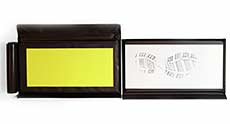
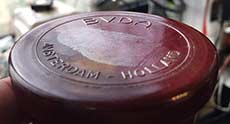
GeneralBVDA Gellifters have been especially developed to lift fingerprints, shoeprints, dust marks and micro traces. The thick, non-aggressive, low-adhesive gelatin layer makes it possible to lift traces from almost every surface, including porous materials such as paper or cardboard. Lifted prints can be taken along for photography or closer examination. The black and the white Gellifters have a carrier of linen
rubber. The transparent Gellifters have a clear polyester film which acts as a
carrier. All Gellifters are protected by a transparent polyester film. Black and
white Gellifters can easily be marked, since the white linen rubber backing can
be written on. The transparent Gellifters have non-stick paper edges, which makes
it easy to mark them and to lift the cover sheet. |
![]() ![]() |
|||||
|
Hint: The Gellifters can easily be cut (before removing the cover sheet) with a pair of scissors to meet the needs of a particular job. Lifted prints or marks can easily be photographed after removing the cover sheet. When the prints have been photographed, the cover sheet can be replaced (after carefully cleaning it to remove any possible contamination). |
![]() |
|
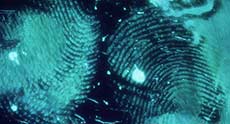
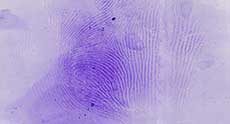
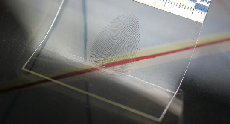
Lifting cyanoacrylate developed fingerprintsThe black Gellifters can be used to lift fingerprints which are developed with cyanoacrylate (an example in a pop-up window). These lifters are a last resort where:
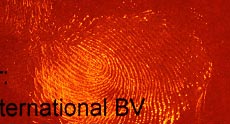
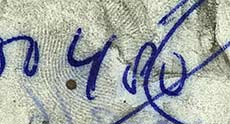
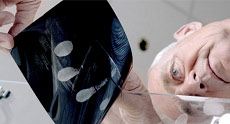
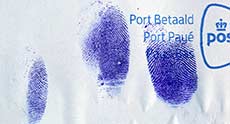
Due to the extreme sensitivity of the black gelatin layer of the lifters, a fingerprint is easily copied onto the lifter by applying the lifter over the developed fingerprint. After removing the lifter, the fingerprint on the lifter can easily be viewed and photographed using coaxial lighting (as described in the section, "Indented writing"). Often the photographs produced after lifting a print with a black Gellifter are better and sharper than the same print photographed in fluorescence. Hint: the second lift of the same fingerprint is often even better, because the first lift removes most of the background. Lifting untreated fingerprintsEven fingerprints that have not been treated with powders or cyanoacrylate can be lifted with black Gellifters (example in a pop-up window). An object on which prints are suspected, but which is difficult to treat (for example a plastic surface) can be searched for prints by applying a black Gellifter. Due to the extreme sensitivity of the black gelatin layer of the lifters, a fingerprint is easily copied onto the lifter by applying the lifter over the untreated fingerprint. Another example is a strong print that is already visible with the naked eye. To retain the perfect detail that these prints can have, they could be lifted before powdering is done. Viewing and photographing these kinds of lifted prints is done in the way described under the heading "Indented writing": almost coaxial lighting. Special Techniques for Lifting FingerprintsDouble liftingOften, a print developed with fingerprint powder can be lifted twice. The second lift will in many cases be much clearer, although it will have less contrast. Another possibility is lifting for a second time after additional dusting. Of course no rules can be given for these techniques, as much depends on experience. However, this is recommended for fingerprints on aluminium. Improving older fingerprints
ShoeprintsLifting shoeprintsThese are usually prints where the sole of the shoe acts as a stamp on the surface, thereby leaving an invisible print or one which is barely visible. The surfaces from which shoeprints can be lifted using BVDA Gellifters, are all smooth, hard surfaces such as floors, painted wood, paper, table-tops etc. For lifting shoeprints (dust marks), the large black Gellifters B-12000 (13x36 cm / 5.2x14.4") and B-12500 (18x36 cm / 7.2x14.4") are commonly used. Footwear impressions that are not visible to the naked eye can be found in a number of ways. The best known method is to use a torch or floodlight at a low angle. Because shoeprints that are not even visible using low angle lighting, can be seen once they have been lifted with black Gellifters, another method is to cover the whole area where shoeprints are suspected, with Gellifters. We even supply extra large Gellifters 36x50 cm / 14.4x20") for this purpose. When the entire area is covered with Gellifters, reconstruction of the pattern is facilitated by drawing stripes over the seams of the Gellifters. Before picking up the Gellifters, it may be advantageous to let them lie on the surface for some minutes, so as to humidify the print. Another method of searching for shoeprints that should be mentioned, is the use of electrostatic lifting. Since electrostatic lifting leaves more than enough residue for subsequent lifting with a Gellifter, it can be used before gel lifting. Because electrostatic lifting also removes a lot of background dust, usually even better lifts are obtained with the Gellifter afterwards rather than using the latter on its own.
Even if shoeprints do not show up when lighting the surface and are not visible after lifting, they may become apparent when obliquely lighting the surface of the Gellifter in a dark room (after removing the cover sheet). Gellifters with no apparent prints in normal light, now show a highly detailed image. After photography, the cover sheet can be replaced following careful cleaning. A large roller is very convenient when replacing the cover sheet on these large Gellifters, so as to avoid trapping air bubbles. Shoeprints which have been rendered visible with fingerprint powders, such as Magnetic Jet Black or Silver Special, can also be lifted with BVDA Gellifters. The color of the Gellifter used depends on the color of the fingerprint powder, e.g. a white lifter for dark color powder and a black lifter for light color powder. WARNING: Avoid contamination of the Gellifters once the cover sheet has been removed. We recommend wearing dust-free clothing when handling and photographing the Gellifters. Longevity of lifted shoeprintsLifted shoeprints (dust marks) may slowly fade in time. For very weak prints this may be noticeable after storing them for a few days. This will depend on the temperature. The lower the temperature, the slower they will fade. This, however, should not be a concern, since lifted shoeprints can easily be photographed after removing the cover sheet. Oblique lighting will show details which are not visible before photography. So far, we know of no materials that fade on the Gellifter surface before adequate photographs have been taken. For best results you should not replace the cover sheet. Transportation of the lifted print is of course more difficult then. We suggest using double-sided adhesive tape and a clean, shallow cardboard box, like the ones that photographic paper comes in. When shoeprints contain very coarse material, e.g. sand, you may expect difficulties when replacing the cover sheet. Small air bubbles are likely to collect around coarse particles. If too many are present, the cover sheet will not adhere properly to the Gellifter. Several measures can be taken to avoid these problems. First of all, it may be advisable to photograph the shoeprint before lifting it. Secondly, the lifted print can be photographed on the crime scene before the cover sheet is replaced. Thirdly, instead of replacing the cover sheet, the Gellifter can be put in a clean box (e.g. a photographic paper box) and taped to the bottom. Fourthly, the cover sheet can be secured to the Gellifter with staples or adhesive tape, to prevent movement which would allow the coarse particles to destroy characteristic details. next page
»» |
| HOME | | | ABOUT US | | | CONTACT | | | SEARCH | | | PRODUCTS | | | PRODUCT INFORMATION | | | DOWNLOAD CATALOGUE | | | THIS PAGE IN |
|